
Technical Specifications and User Manual
Variant 1: KH2D37CB and variant 2: KH2D37CI
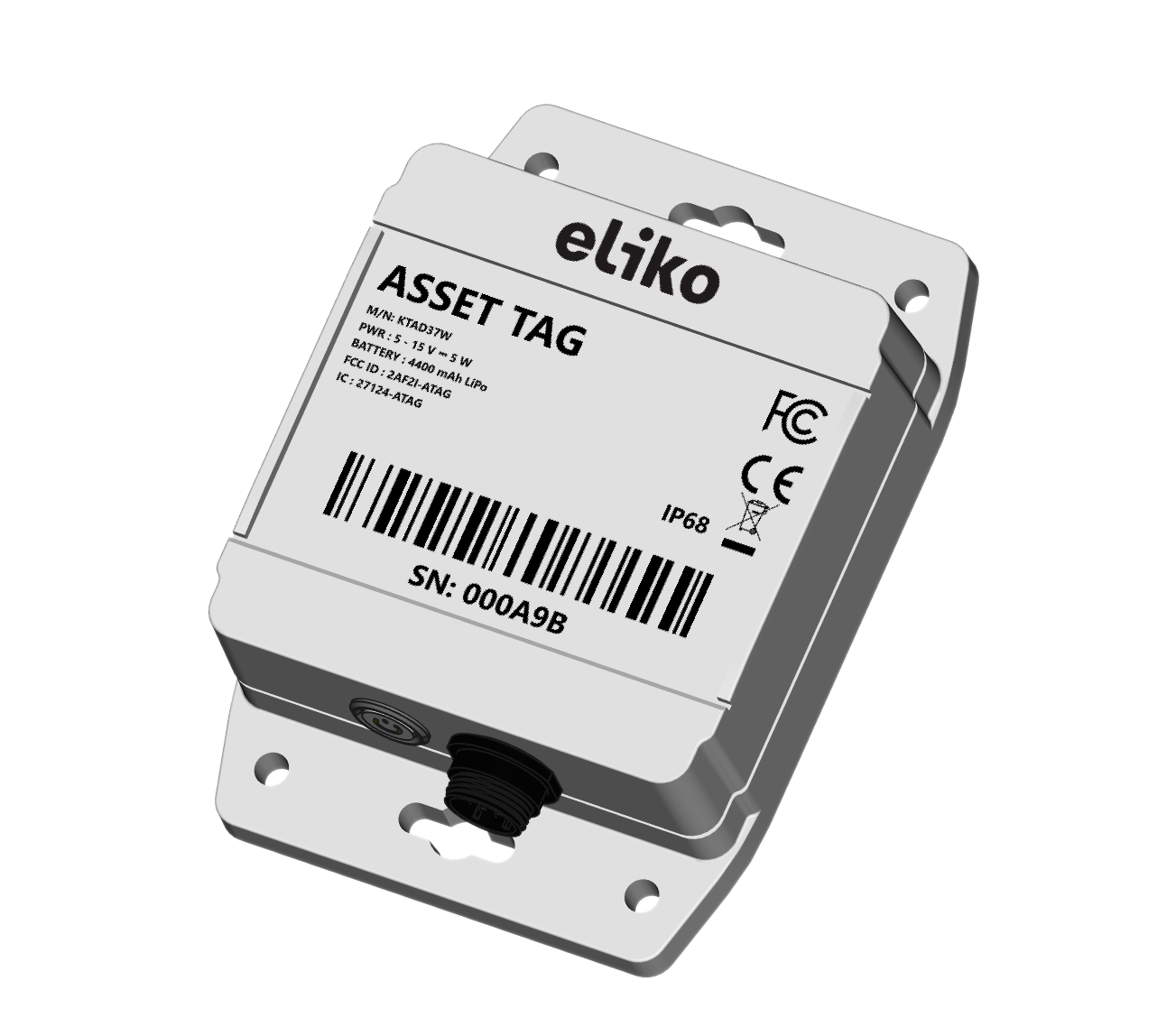
Eliko RTLS asset tag is designed for tracking large objects in industrial environments. The asset tag is weather and dust proof in a certified IP67 enclosure. The asset tag is tested according to MIL-STD-810G standard and is shock and vibration proof.
The asset tags comes in two variants:
-
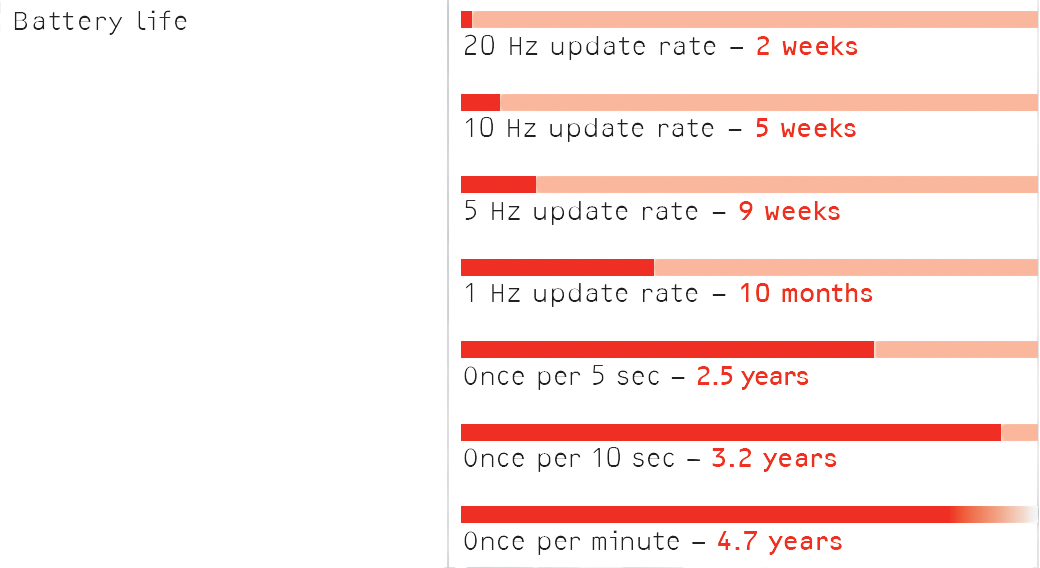
The variant with model nr KH2D37CB contains a 4400 mAh 3.7 V LiPo battery. On a single charge, the battery lifetime is up to 4.7 years.
-
The variant with model nr KH2D37CI contains an additional 6 DoF IMU device and can output separate accelerometer and gyroscope data. It does not contain an internal battery.
Figure 1. Eliko RTLS Asset Tag
1. General Overview
The Asset tag can be used in two types of setups - the RTLS setup and the Tag-to-Tag setup.
The RTLS setup includes static Eliko RTLS anchors, which are mounted on the walls or ceilings and mobile Eliko RTLS tags, which are attached to the tracked objects. The anchors collect distance measurements between themselves and tags, and send this information to the RTLS software. The RTLS software runs locally either on the Eliko or the client managed hardware and provides data to the client applications via an API.
The Tag-to-Tag setup enables measuring distance between two Eliko RTLS tags. It is useful for collision-avoidance applications either using one or more Eliko RTLS tags on each tracked object or person. The relevant document that describes this functionality is Eliko RTLS Asset Tag - Hybrid Mode.
2. Operating Instructions
The device is automatically switched ON when power is connected to it and remains always so. A green LED on the button indicates the device is powered and operational.
Asset tag variant with a battery (KH2D37CB) can also be switched ON and OFF when there is no external power connected to it. This is done by pressing the button until the green LED on the button makes a fade-in (power ON) or fade-out (power OFF).
NB! Pressing the button briefly initiates a software restart of the tag (not required during normal operation). The side effect of a restart is that the relative clock used in the distance measurement reports is also restarted.
2.1 Battery Consumption
The Asset tag variant KH2D37CB contains a 4400 mAh 3.7 V LiPo rechargeable battery. When the device is ranging continuously at 1 Hz (1 time per second), the expected battery life is found below:
Figure 2: Battery consumption KH2D37CB
2.2 LED Feedback
The device contains a single green LED (on the single button). The following light patterns are defined:
|
LED pattern |
Description |
USB state |
|
Fade in |
Device startup |
Any |
|
Fade out |
Device shutdown |
Any |
|
Constantly ON |
Battery full |
Connected |
|
ON one second, OFF one second |
Battery charging |
Connected |
|
ON 5 ms, OFF 〜2 seconds (1995 ms) |
Tag is ranging (ie it can “see” and is communicating with at least one anchor). |
Disconnected |
|
ON 5 ms, OFF 〜4 seconds (3995 ms) |
Tag does not “see” any anchors. |
Disconnected |
|
ON 5 ms, OFF 〜6 seconds (5995 ms) |
Ranging disabled (tag is not communicating with the anchors because this functionality has been disabled by the user). Does not happen during normal operation, only in special applications and during software maintenance/configuration over USB. |
Disconnected |
|
ON 5 ms, OFF 〜8 seconds (7995 ms) |
Battery empty, connect charger (only KH2D37CB). |
Disconnected |
|
ON 5 ms, OFF 95 ms |
Firmware flashing in progress |
Any |
|
ON 250 ms, OFF 250 ms |
Alarm patterns 1-8 |
Any |
|
ON 400 ms, OFF 400 ms |
Bad power supply (tag blinks 5 times and then turns OFF) |
Any |
|
1-4 blinks ON 250 ms, OFF 500 ms, then pause for 3 seconds |
Hardware fail, please report the number of blinks to Eliko. |
Any |
3. Hardware
3.1 Specifications
|
Type |
Variant 1 with Battery KH2D37CB |
Variant 2 with IMU KH2D37CI |
|
Dimensions |
130x90x38 mm (LxWxH) |
130x90x38 mm (LxWxH) |
|
Weight |
260 g |
175 g |
|
Operational Range (1) |
50 m (UWB Channel 5) |
50 m (UWB Channel 5) |
|
Interface |
7 pin WEIPU SP13 connector for powering, firmware update and controlling external devices |
7 pin WEIPU SP13 connector for charging, firmware update and controlling external devices |
|
Power Supply(2) |
9-24 V DC |
9-24 V DC |
|
Power Consumption max |
6 W |
1.5W |
|
Operating Temperature(3) |
-10 … +47 °C |
-25...+60 °C |
|
IP Class |
IP67(4) |
IP67(4) |
|
Sensor |
- |
Accelerometer, Gyroscope |
|
Feedback |
LED on Button |
LED on Button |
|
Battery |
3.7 V 16.28 Wh |
- |
|
Battery charge time(5) |
7 h |
- |
|
Shock and Vibration Testing |
|
MIL-STD-810G |
-
Presence of other radio equipment operating at the same frequency can reduce the operating range. For the receiver test, that tests the influence of an interferer signal to the device, the following performance criterion has at least the following level of performance (ETSI TS 103 361).
-
When the Asset Tag is used as fixed equipment, the maximum allowed cable length is 3 m. Device is considered to be fixed equipment when it is powered by AC mains or DC network. Few examples:
-
Device charging from AC mains using AC/DC adapter, b) Device is attached to wall and powered through AC/DC adapter.
-
-
The operating temperature is meant in discharge mode. Operating mode while charging is maximum 32°C. Battery charging is terminated when battery temperature is less than +14 °C or above 41°C. Also charging speed is reduced while battery temperature is less than +19°C or above 31°C
-
During testing the device is submerged at depth (15cm / 1M) for 30 minutes.
-
Charge time is only valid when the battery temperature is in the range of 19 …31°C. Please note that during charging of the device, internal temperature may be 10 degrees more than ambient therefore it is recommended to charge at cooler temperatures and keep the device in a well-ventilated area.
-
3.2 Connector
The connector is a 7 pin WEIPU SP13 with the following characteristics:
|
Contact diameter (mm) |
1 |
|
Contact resistance (mΩ) |
5 |
|
Wire size (mm² / AWG) |
≤0.75 / 18 |
Pin designation:
|
1 |
Power (9-24 V DC) |
|
2 |
Ground 0 V |
|
3 |
GPO (5 VDC 100mA while source and 24 VDC 100mA while sink |
|
4 |
USB VCC* |
|
5 |
D- |
|
6 |
D+ |
|
7 |
Ground |
-
Power must be provided to the device through Pin 1 (Power). The device can’t be powered via USB VCC.
Note: The device is IP67 compliant only in case the mating connector is fully inserted and secured or there is a cap on the connector.
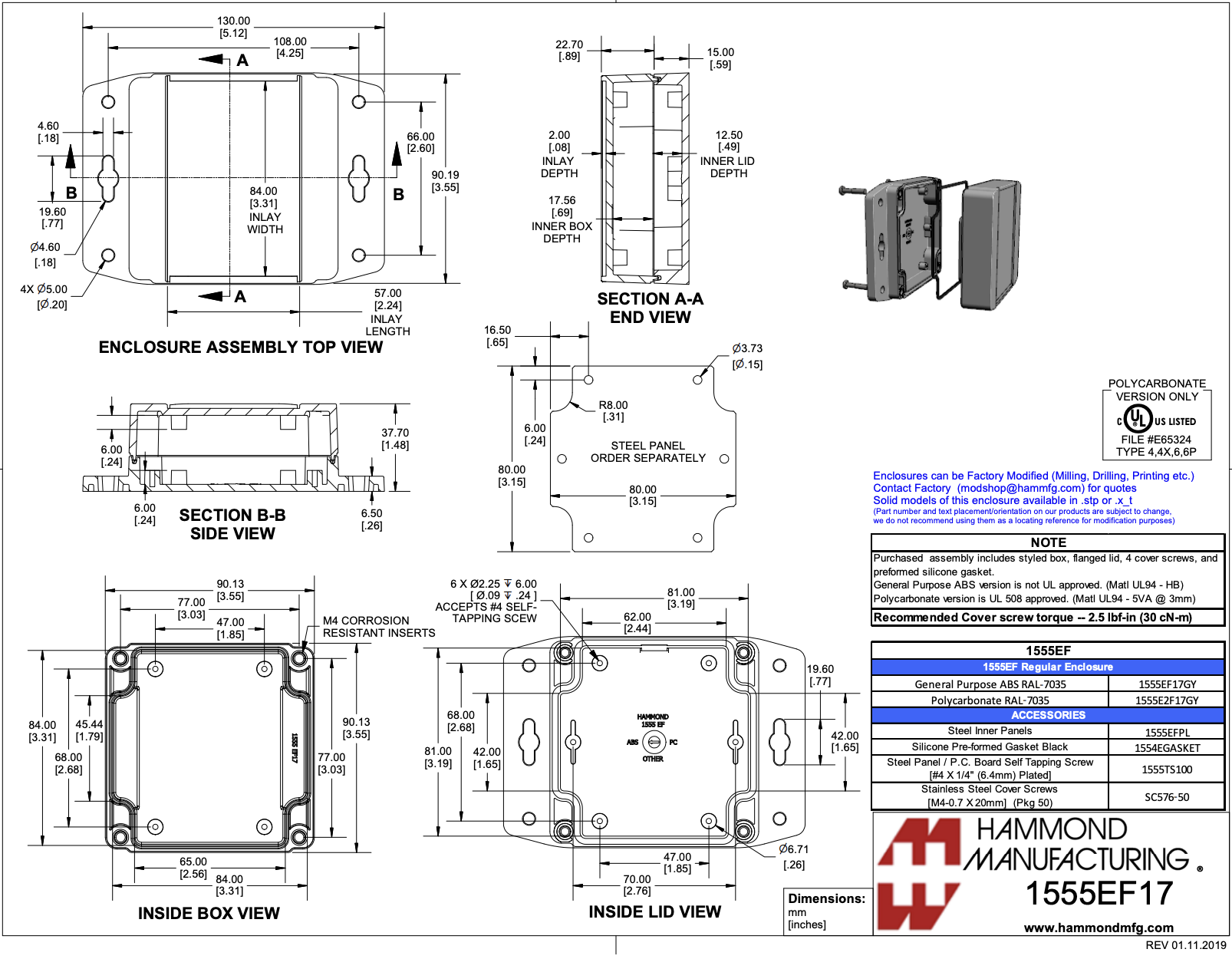
Enclosure
3.4 Attachment Options
The Asset tag can be attached to trackable objects in multiple ways. Please choose the appropriate option based on your use case and preference.
The asset tag can only be mounted on objects less than 2m in height.
Magnetic attachments are convenient for objects. Magnetic attachment can be supplemented with felt lining to prevent any damage on the object’s surface.
Two-sided tape - the tape type and length should be chosen in a way that the tape withstands weight of at least 1 kg.